These competition projects represent an opportunity to explore architecture beyond conventional constraints. Each proposal is a response to a unique challenge, investigating the relationship between place, form, atmosphere, and human experience through thoughtful design and experimentation.
Acordeon and Cerc la Cub were developed as responses to an open call for a performance space for Romanian Creative Week in Iași. Both proposals explore the relationship between architecture, culture, and public space, investigating how temporary and permanent interventions can activate the urban environment and create meaningful encounters between people and place.
While sharing the same objective, to provide a flexible setting for performances, events, and social interaction, the two projects approach the challenge from different perspectives. Cerc la Cub proposes a permanent presence within the city, acting as a landmark and cultural anchor, while Acordeon explores mobility and adaptability through a lightweight structure capable of transforming multiple urban locations and was awarded Second Place in the competition. Together, the projects reflect an interest in architecture as a catalyst for community engagement, cultural expression, and dynamic public life.
ACORDEON
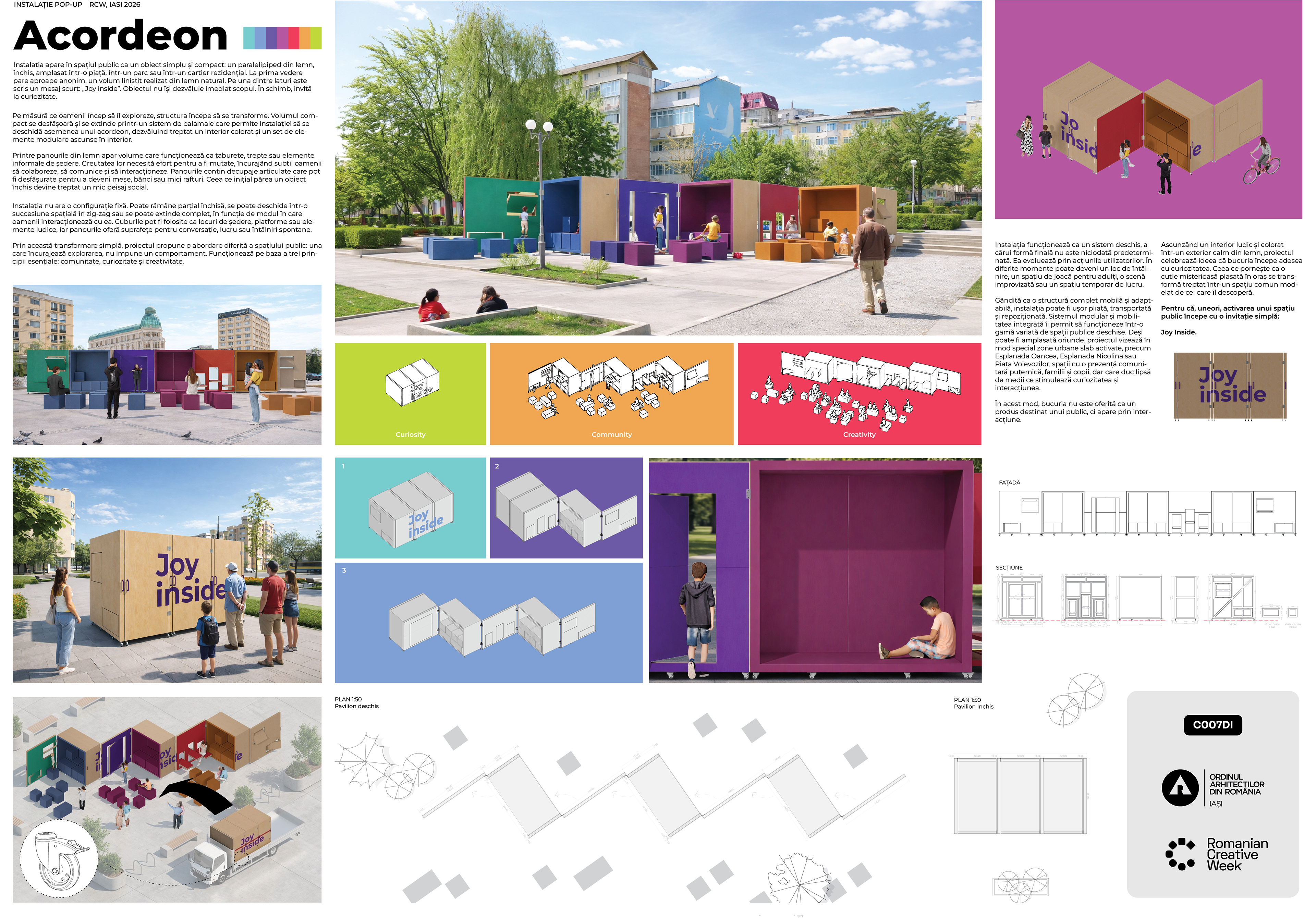
The installation appears in the public realm as a simple and compact object: a closed wooden rectangular volume placed within a square, park, or residential neighborhood. At first glance, it seems almost anonymous, a quiet structure made of natural wood. On one of its sides, a short message is inscribed: “Joy inside.”
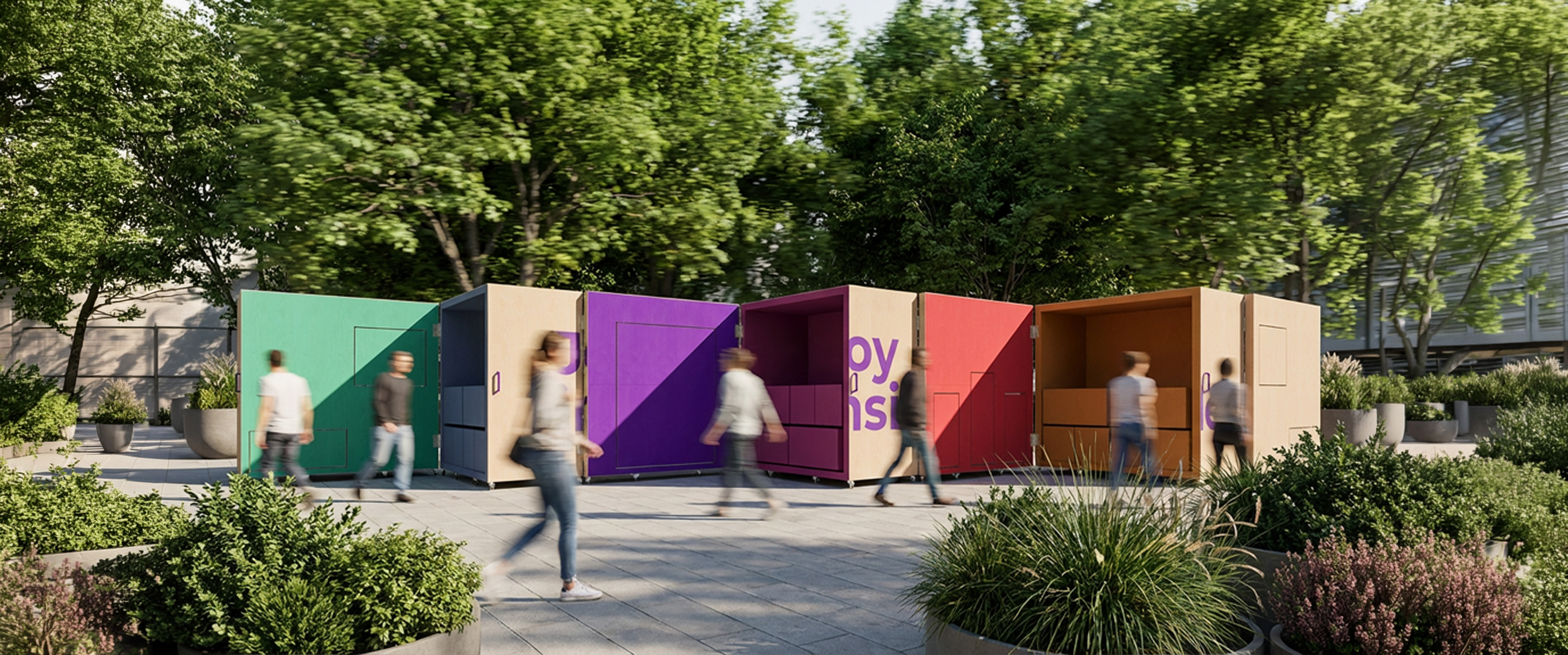
The object does not immediately reveal its purpose. Instead, it invites curiosity. As people begin to explore it, the structure starts to transform. The compact volume unfolds and expands through a hinged system that allows the installation to open like an accordion, gradually revealing a colorful interior and a series of modular elements hidden within.
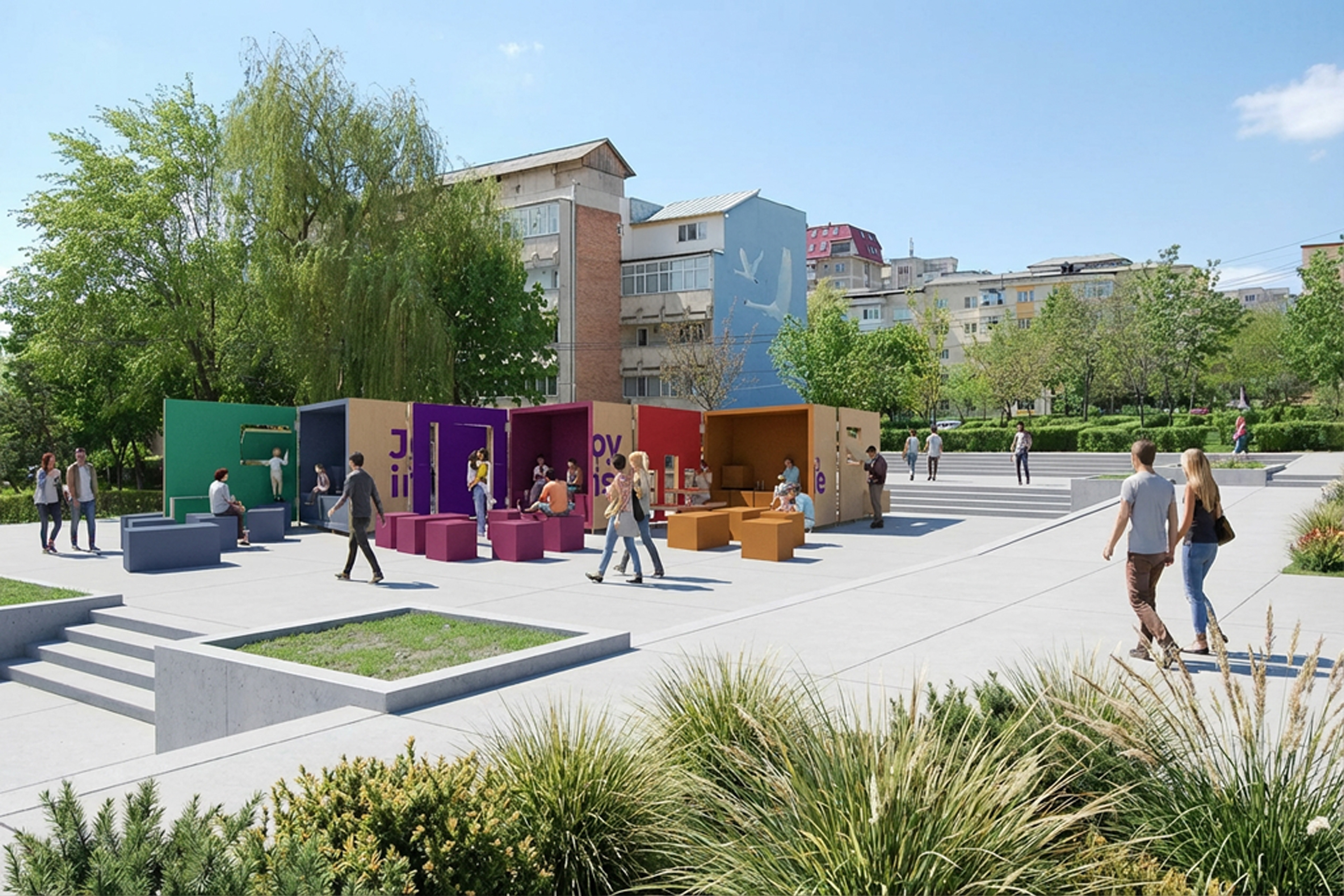
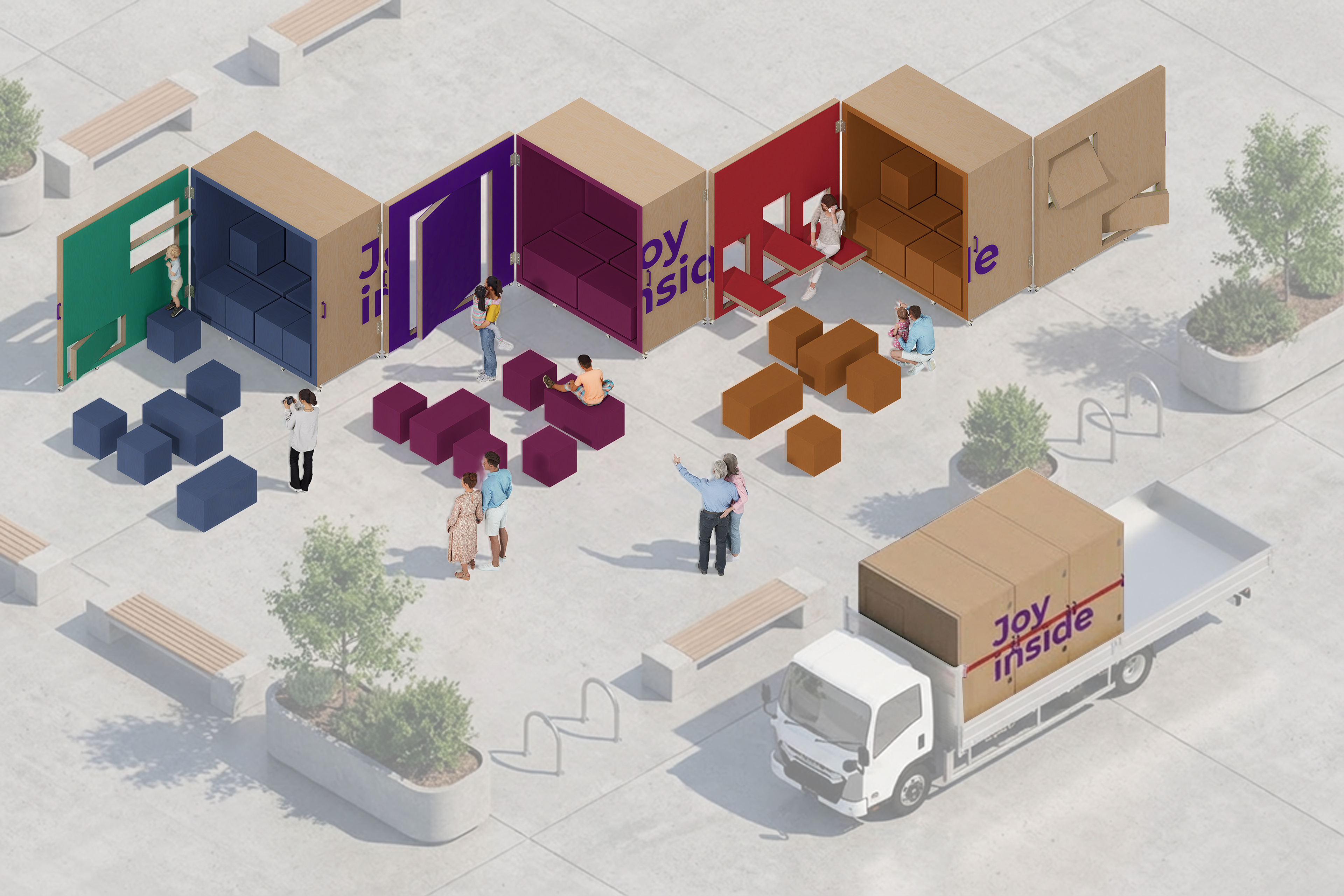
Between the wooden panels, volumes emerge that function as stools, steps, or informal seating elements. Their weight requires effort to move, subtly encouraging people to collaborate, communicate, and interact. The panels contain articulated cut-outs that can unfold into tables, benches, or small shelves. What initially appears to be a closed object gradually becomes a small social landscape.
The installation has no fixed configuration. It can remain partially closed, open into a zigzag spatial sequence, or expand fully, depending on how people choose to engage with it. The modular elements can be used as seating, platforms, or playful objects, while the panels provide surfaces for conversation, work, and spontaneous gatherings. Through this simple transformation, the project proposes a different approach to public space, one that encourages exploration rather than prescribing behavior. It is built around three essential principles: community, curiosity, and creativity. The installation functions as an open system whose final form is never predetermined. It evolves through the actions of its users. At different moments, it can become a meeting place, a playground for adults, an improvised stage, or a temporary workspace.
Conceived as a fully mobile and adaptable structure, the installation can be easily folded, transported, and relocated. Its modular system and integrated mobility allow it to operate within a wide variety of public spaces. While it can be placed almost anywhere, the project specifically targets underactivated urban areas such as Esplanada Oancea, Esplanada Nicolina, and Piața Voievozilor—spaces with strong community presence, families, and children, yet lacking environments that stimulate curiosity and interaction. In this way, joy is not presented as a product offered to an audience, but rather emerges through participation.
By concealing a playful and colorful interior within a calm wooden exterior, the project celebrates the idea that joy often begins with curiosity. What starts as a mysterious box placed within the city gradually transforms into a shared space shaped by those who discover it. Because sometimes activating public space begins with a simple invitation: Joy inside.
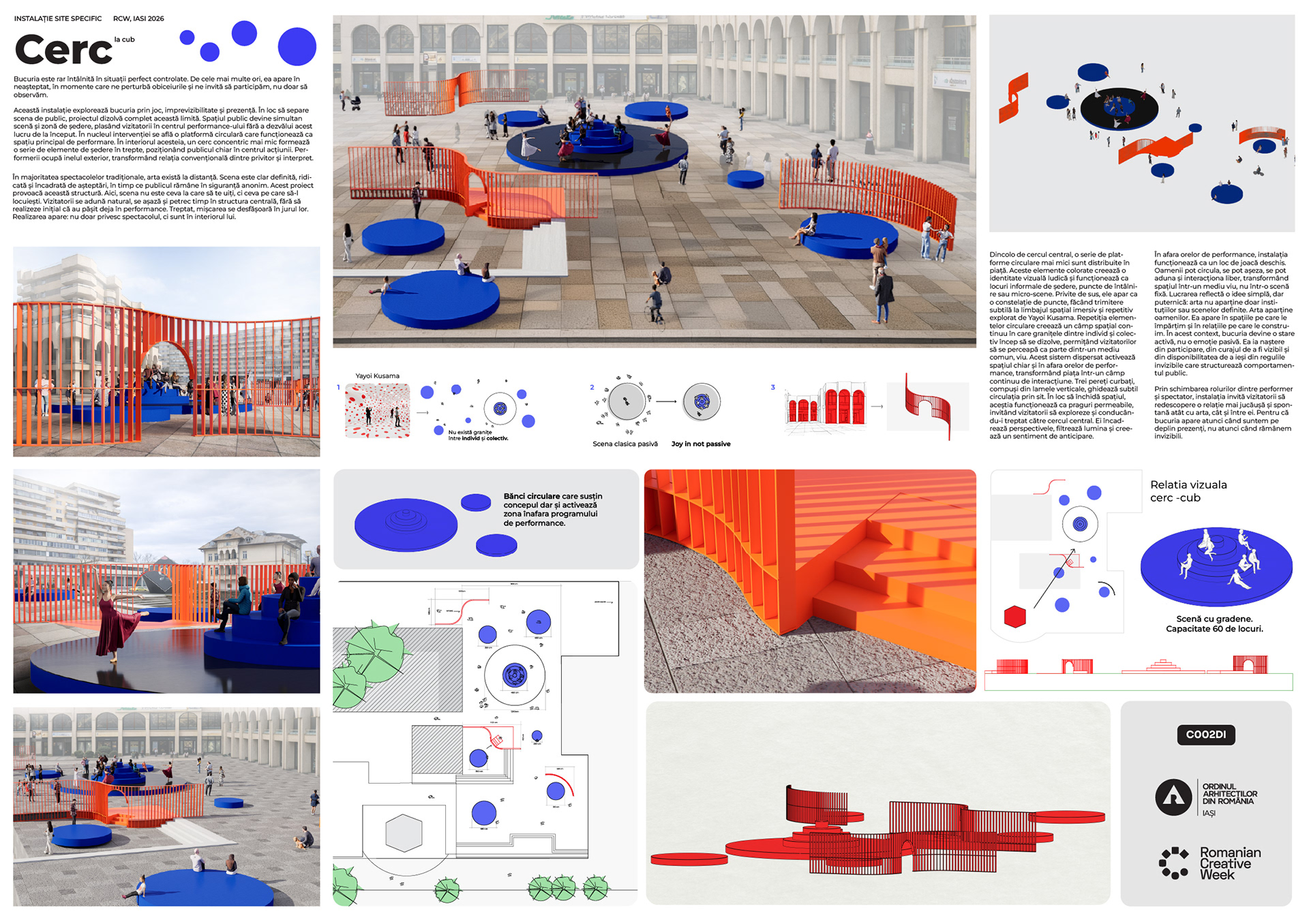
CERC LA CUB
Joy is rarely found in perfectly controlled situations. More often, it emerges through the unexpected, in moments that disrupt our routines and invite us to participate rather than simply observe.
This installation explores joy through play, unpredictability, and presence. Instead of separating the stage from the audience, the project dissolves this boundary entirely. Public space becomes both performance venue and gathering place, positioning visitors at the center of the event without revealing it from the outset.
At the heart of the intervention is a circular platform that functions as the primary performance space. Within it, a smaller concentric circle forms a series of stepped seating elements, placing the audience directly at the center of the action. Performers occupy the outer ring, reversing the conventional relationship between spectator and performer.
In most traditional performances, art exists at a distance. The stage is clearly defined, elevated, and framed by expectations, while the audience remains safely anonymous. This project challenges that structure. Here, the stage is not something to watch but something to inhabit. Visitors naturally gather, sit, and spend time within the central structure, often without realizing they have already entered the performance. Gradually, movement unfolds around them. A realization emerges: they are not simply watching the performance, they are inside it.
Beyond the central circle, a series of smaller circular platforms are distributed throughout the square. These colorful elements create a playful visual identity while functioning as informal seating, meeting points, and micro-stages. Viewed from above, they appear as a constellation of dots, subtly referencing the immersive and repetitive spatial language explored by Yayoi Kusama. The repetition of circular forms creates a continuous spatial field where the boundaries between individual and collective begin to dissolve, allowing visitors to perceive themselves as part of a shared and living environment.
This dispersed system activates the public space even outside performance hours, transforming the square into a continuous landscape of interaction. Three curved walls composed of vertical slats subtly guide circulation through the site. Rather than enclosing space, they act as permeable thresholds, inviting exploration and gradually leading visitors toward the central circle. They frame views, filter light, and create a sense of anticipation.
Outside performance hours, the installation functions as an open playground. People can move freely, sit, gather, and interact, transforming the space into a living environment rather than a fixed stage. The project reflects a simple yet powerful idea: art does not belong exclusively to institutions or designated venues. Art belongs to people. It emerges within the spaces we share and through the relationships we build.
In this context, joy becomes an active condition rather than a passive emotion. It arises through participation, through the courage to be visible, and through the willingness to step beyond the invisible rules that shape public behavior.
By reversing the roles of performer and spectator, the installation invites visitors to rediscover a more playful and spontaneous relationship with both art and one another.
Because joy emerges when we are fully present, not when we remain invisible.